About Nepal
Nepal is a country of amazing extremes. Its beauty evokes the kind of magic that few tourists destinations in the world can hope to match. The elevation of the country ranges from 60 meters above sea level to the highest point on earth, Mt. Everest 8848 meters, all within a distance of 150 kilometers resulting in climatic conditions from sub-tropical to arctic. The northernmost strip is mountainous which includes 8 of the 10 highest mountains in the world including the highest Mt. Everest 8848 meters (Sagarmatha).
Nepal is a land of great aesthetics, the greatest of them being the Lord Buddha who was born in the erstwhile kingdom of Lumbini. It is also a treasure trove of culture and architecture. Monuments, temples and monasteries dating back to per-historic period abounds her historic cities. Nepal is home to ethnic groups and sub-groups speaking over 93 languages and dialects.
Nepal offers an astonishing diversity of sightseeing attractions and adventure opportunities found nowhere else on earth. Nepal provides something for everybody- tourist, trekker, river runner, wildlife, enthusiast, poet, artist, scholar or the weary in search of a personal Shangrila. Numerous annual festivals are celebrated throughout the year in traditional style highlighting enduring customs and beliefs.
Nepal occupying only 0.1 % of the total landmass of the earth- is home to:
2% of all the flowering plants in the world;
8% of the world’s population of birds (more than 848 species);
4% of mammals on earth;
11 of the world’s 15 families of butterflies more than 500 species;
600 indigenous plant families;
319 species of exotic orchids.
Area: 147,181 Sq. Km
Location: Situated between China in the north and India in the south, east and west.
Capital: Kathmandu
Population: 23.1 Million
Language: Neapli is the national language, written in Devnagari script. Many different ethnic groups have their own languages for dialects. However travel-trade people understand and speak English.
People and Culture: Nepal has more than 101 ethnic groups and 93 spoken languages.
Religion: Hindus and Buddhism constitute two major religions of Nepal.
Climate: Nepal has four climatic seasons
- Spring: March-May,
- Summer: June-August
- Autumn: September-November and
- Winter: December-February
Nepal can be visited the whole year round.
Currency: Nepalese Rupees (NRS.) (approximately US$ 1 equals NRs. 71 as of February 2007)
National Bird: Impend Pheasant Danfe
National Flower: Rhododendron arboretum (LALI GURANS)
Political System: Multi- party Democracy.
What to wear: Light weight clothing is recommended for May through October. Warm garments are required in October-March. An Umbrella or a raincoat is a must for the rainy season.
Traveller's Information
Entry Procedures & Visa Rules
a. Tourist Visa
Visa Facility Duration Fee
Multiple entry 15 days US$ 25 or equivalent convertible currency
Multiple entry 30 days US$ 40 or equivalent convertible currency
Multiple entry 90 days US$ 100 or equivalent convertible currency
b. Gratis (Free) Visa
• Gratis visa for 30 days is available only for nationals of SAARC countries. However, for extension of visa for SAARC nationals, the rule is same as that of other nationals.
• Indian nationals do not require visa to enter into Nepal.
For Visa Extension:
Tourists can stay for a maximum of 150 days in a visa year (Jan 1 to Dec 31) extending the visa at the rate of 2 US $ per day. However, a minimum amount of 30 US$ has to be paid for a period of 15 days or less.
For obtaining visa or for renewing visa one passport size photo is necessary.
(For further information, please, contact Department of Immigration, Maitighar, Impact Building, Kathmandu, Tel: 00977-1-4221996/ 4223590/ 4222453, Web: www.immi.gov.np )
Custom Formalities
Customs:
All baggage must be declared and cleared through the customs on arrival at the entry point. Personal effects are permitted free entry. Passengers arriving at Tribhuvan International Airport (TIA) without any dutiable goods can proceed through the Green Channel for quick clearance without a baggage check. If you are carrying dutiable articles, you have to pass through the Red Channel for detailed customs clearance.
Import:
Apart from used personal belongings, visitors are allowed to bring to Nepal free of duty: cigarettes (200 sticks) or cigars (50 sticks), distilled liquor (one 1.15 liter bottle), and film (15 rolls). You can also bring in the following articles free of duty on condition that you take them out with you when you leave: binoculars, movie or video camera, still camera, laptop computer, and portable music system.
Export:
The export of antiques requires special certification from the Department of Archeology, National Archive Building, Ram Shah Path, Kathmandu. It is illegal to export objects over 100 years old, such as sacred images, paintings, manuscripts that are valued for culture and religious reasons. Visitors are advised not to purchase such items as they are Nepal's cultural heritage and belong here.
For more information on customs matters, contact the Chief Customs Administrator, TIA Customs Office (Phone: 4470110, 4472266).
--------------------------------------------------------------------------------
Foreign Currency and Credit Cards
Payment in hotels, travel agencies, and airlines are made in foreign exchange. Credit cards like American Express, Master and Visa are widely accepted at major hotels, shops, and restaurants. Remember to keep your Foreign Exchange Encashment Receipt while making foreign exchange payments or transferring foreign currency into Nepalese rupees. The receipts may be needed to change left-over Nepalese Rupees into hard currency before leaving the country. However, only 10 percent of the total amount may be converted by the bank. ATM is widely in use in Kathmandu.
Major banks, hotels and exchange counters at Tribhuvan International Airport provide services for exchanging foreign currency.
Exchange rates are published in English dailies such as The Rising Nepal, The Kathmandu Post and The Himalayan Times. Nepalese Rupees are found in denominations of Rupees 1000, 500, 100, 50, 20, 10, 5, 2 and 1. Coins are found in denominations of Rupees 5, 2 and 1. One rupee equals 100 paisa.
Time and Business Hours
Nepal is five hours 45 minutes ahead of GMT.
Business hours within the Valley: Government offices are open from 10 am to 5 p.m. from Sunday through Thursday and close at 3pm on Friday in the Kathmandu Valley. During the winter, they close at 4 pm. Most Business offices are open from 10 am to 5 p.m. Sunday through Friday. Embassies and international organizations are open from 9 am to 5 pm Monday through Friday. Most shops open after 10 am and close at about 8 pm and are usually closed on Saturdays.
Business hours outside the Valley: Government offices outside Kathmandu valley open from 10 am to 5 p.m. from Sunday through Thursday. On Fridays they remain open until 3 pm. Banks are open from Sunday through Thursday from 10 am to 3 pm. On Fridays, banks remain open until 12 pm only. Business offices are open from 10 am to 5 pm Sunday through Friday. Recently many private banks have re-organized to have different branches open at various different times making banking hours longer. If one branch is closed another will be open.
Holidays: Nepal observes numerous holidays, at the least a couple in a month. So please check the holiday calendar. The longest holiday in Nepal is during the Dashain festival in late September or October. Government offices observe all the national holidays and banks observe most of them. Businesses observe major holidays only.
--------------------------------------------------------------------------------
Communication Facilities
Postal Services: The Central Post Office located near Dharahara Tower, is open from 10 a.m. to 5 p.m. Sunday through Friday. The counters are open from 10 a.m. to 4 p.m. and provide stamps, postcards and aerograms. Post Restante is available Sunday through Friday from 10 a.m. to 5 p.m. Express Mail Service (EMS) is available at GPO and at Thamel, Basantapur and airport postal counters.
Telephone Services: Telephone and fax services are available at the Nepal Telecommunications Corporation at Tripureshwar. Hotels and private communications centers provide long distance telephone and fax facilities. For calling from outside, country code for Nepal is 977 and the area code for Kathmandu is 1.
Internet Services: There are countless Internet cafes and communication centers have opened up in the Valley and around the country. Visitors only have to find a place they are most comfortable in to use the facilities to keep in touch with home. Internet services are also offered by hotels.
Media: Nepali media has made a gigantic leap ahead in just a few years time and what used to be a controlled and tight knit community, is no more. The government audio and television news networks are Radio Nepal and Nepal Television respectively. However, numerous FM radio stations and regional television stations are dominating the market. Major Nepali daily newspapers are Gorkhapatra and Kantipur, while the English dailies are The Rising Nepal, The Kathmandu Post and The Himalayan Times. A number of other newspapers and magazines are also available.
Electricity: Major towns have electricity and the voltage available is 220-volts and 50 cycles. Load shedding is a seasonal phenomenon during the dry season and eases off once it begins to rain. However, most major hotels have uninterrupted power supply through their own generators.
SOME DO’S AND DON'TS
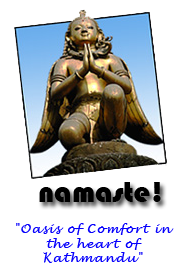
- The form of greeting in Nepal is "NAMASTE" and is performed by joining the palms together.
- Before entering a Nepalese home, temple, and stupa remember to remove your shoes.
- Be careful not to use your spoon, fork or a hand being used for your eating to touch other's food, plate, cooking utensil or the serving dish. Do not eat from other people's plate and do not drink from other people's bottle or glass. It is considered impure by the Nepalese.
- Never touch anything with your feet. This is considered an offence among Nepalese.
- While travelling dress appropriately. Women should specially avoid dressing in skimpy outfits.
- Seek permission first before entering a Hindu temple. Many Hindu temples do not allow westerners or non-Hindus to enter.
- Leather articles are prohibited to be taken inside the temple precinct.
- Walking around temples or stupas is traditionally done clockwise.
- Take photographs only after receiving permission for the object or person being photographed.
- Public displays of affection between man and woman are frowned upon. Do not do something that is totally alien to our environment.
- Remember, many times, when a person shakes his head from left to right, he may mean "Yes".
- Develop a genuine interest to meet and talk to Nepalese people and respect their local customs.
|